 |
The Story Of Lustron Homes
by Judy Reickert |
"During World War II, Kilroy* was there."
When the war ended in the European and Pacific theaters, Kilroy came back here, rarin to marry the girl hed left behind, buy a home, start a family and participate in the post-war American dream of the late 1940s. But realizing that dreams domestic interludes wasnt a simple proposition. The G.I.s mass return stateside compounded a residential housing shortage that had plagued the home front throughout the war years.
During the war, huge portions of the nations population had crowded into urban areas whose manufacturing centers had retooled and geared up to produce the ships, planes and armaments that powered the war effort. With the wars end, the human tide that had flooded the nations cities showed no indication of subsiding...and the vets were headed home.
Enter Carl Strandlund, a Chicago-based entrepreneur representing a manufacturing firm with post-war plans to fabricate porcelain-enameled cold-rolled steel panels for the construction of pre-fabricated service stations.
As the war came to an end, Strandlund traveled to Washington to investigate the availability of post-war surplus steel, said Nathalie Wright, of the Ohio Historic Preservation Office in Columbus. Strandlund learned that, despite the impending end of the countrys wartime industrial mobilization, a ready supply of surplus steel for building gas stations was far from a sure thing.
However, he did return from his Washington mission with one clear and valuable message: that the timely construction of attractive, permanent, affordable housing for the returning G.I. and his new family ranked among Washingtons highest post-war domestic priorities.
Heeding that message, Strandlund translated the pedestrian principles of pre-fabricated steel panel construction developed for commercial construction into an exciting consumer crusade he believed capable of solving the countrys burgeoning residential housing crisis. Thus arrived the glorious, albeit short-lived, heyday of the Lustron Steel Home.
Leasing space in a former Navy airplane plant in Columbus, Ohio, from the federal government, Strandlunds Lustron Corporation based production of its all-steel panelized prefabricated homes on the assembly-line methods of the automobile industry. Preparing to swing into production, Strandlund secured a $15.5 million federal loan in 1947, and additional loans of $10 million and $7 million from the Reconstruction Finance Corporation in 48 and 49.
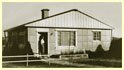
The initial Lustron Home, a two-bedroom, one-bath, 1000-square-foot unit, was a critical success with an efficient 31-by-35-foot floor plan and space-saving built-ins in every room. All interior and exterior surfaces were porcelain-enameled metal, from the roof, gutters and down drains to the master bedrooms built-in vanity.
The colors for the Lustron Home have been chosen by leading designers and color experts, an early promotional brochure proclaimed. Interior colors are designed to make furnishing and decorating easy. Permanent finishes cut down maintenance costs. Exterior colors are distinctive and lend a feeling of quality and permanence.
Although Strandlund didnt live in a Lustron himself, one was erected on the grounds of his Columbus estate, Wright noted. However, he strongly encouraged his management staff to personally experience the advantages of the Lustron life by choosing to live in Lustron homes.
Those advantages, according to Lustron marketing materials, included:
Low upkeep: No painting or redecorating - just use soap and water to keep it clean.
Radiant panel heating: This latest of heating systems maintains constant temperature throughout the home. The absence of air currents carrying dust and soot makes the house easy to keep clean.
Picture Frame Windows: Large picture windows in bedrooms, living room, and dining room provide excellent views and good lighting. One-level Floor Plan: The convenience of one-floor living - no stairs to climb. With the combination dishwasher-clotheswasher-sink, furnace and ample storage space on the first floor, you do not need a basement.
Built-in Features: Every inch of space is utilized. Built-in dishwasher-clotheswasher-sink, bookcase and china cabinets, seven large closets, vanity in master bedroom, sliding doors, overhead storage cabinets, kitchen ventilating fan and many other features are included.
Between 1946 and 1948, Lustron received orders for 20,000 homes through its nationwide dealership network, a testimony to the effectiveness of the companys thoroughly modern advertising campaign...and to the scarcity of conventional, single-family housing in many markets.
Only 2,498 of those orders were filled before the Lustron Corporation declared bankruptcy in 1950.
With the financial support of the federal government and a well-designed, critically-acclaimed product that enjoyed a high degree of public acceptance in a susceptible marketplace, how did Lustron snatch defeat from the jaws of victory after fewer than four years of operation
Opinions vary, but Lustrons slowness to equip its plant and actually initiate production have been cited most frequently. An inadequate or erratic steel supply may have been partially responsible for the firms demise. Marketing experts contend Lustron failed to establish an effective national distribution system to handle its high-volume sales. The construction trades may have worked against the success of a nationally-distributed prefabricated, all-steel house. Residential building codes in some municipalities may have discouraged or banned the erection of prefabricated residential structures.
Ultimately, the Lustrons price may have been the deciding issue. In a prefabricated housing market with average prices ranging from $5,500 to $8,500 (excluding land), the two-bedroom Lustron Home model cost $10,000 to $12,000.
In an end-run strategy to address Lustrons price position dilemma, an updated Lustron product brochure, probably published in 1949 or 50 and costing 35-cents, included a special section by Senator Joe McCarthy explaining government (financial) aids - FHA and G.I. loans - to prospective homeowners.
The Lustron Corporations brief production period notwithstanding, the homes produced by the ill-fated firm currently enjoy loyalty from some Lustron residents that borders on fanaticism. My Lustron survived a big hail storm, a Rochester, Minnesota, Lustron owner bragged on one of several web sites devoted to the prefabs.Does anyone have any disassembled Lustron homes, a prospective owner recently queried on a Lustron e-bulletin board.
Apparently successful, that same Lustron owner wannabe asked a couple weeks later, Whats the farthest a Lustron home has been moved
Other Lustron aficionados are organizing a national Lustron registry on the web.
Apparently, despite the dreams spectacular failure in reality, Carl Strandlunds vision of housing post-war America in attractive, efficient, relatively affordable homes still has an undeniable appeal.
*Kilroy
"Kilroy was here" as reported at Wikipedia [http://en.wikipedia.org/wiki/Kilroy_was_here]
"Kilroy was here"is an American popular culture expression, often seen in graffiti. Its origins are open to speculation, but recognition of it and the distinctive doodle of "Kilroy" peeking over a wall is almost ubiquitous among U.S. residents who lived during World War II through the Korean War.
The phrase appears to have originated through United States servicemen, who would draw the doodle and the text "Kilroy Was Here" on the walls or elsewhere they were stationed, encamped, or visited. Brewer's Dictionary of Phrase and Fable notes that it was particularly associated with the Air Transport Command, at least when observed in the United Kingdom.
One theory identifies James J. Kilroy, an American shipyard inspector, as the man behind the signature. During World War II he worked at the Bethlehem Steel Shipyard in Quincy, Massachusetts, where he claimed to have used the phrase to mark rivets he had checked. The builders, whose rivets J. J. Kilroy was counting, were paid depending on the number of rivets they put in. A riveter would make a chalk mark at the end of his or her shift to show where they had left off and the next riveter had started. Unscrupulous riveters discovered that, if they started work before the inspector arrived, they could receive extra pay by erasing the previous worker's chalk mark and chalking a mark farther back on the same seam, giving themselves credit for some of the previous riveter's work. J.J. Kilroy stopped this practice by writing "Kilroy was here" at the site of each chalk mark. At the time, ships were being sent out before they had been painted, so when sealed areas were opened for maintenance, soldiers found an unexplained name scrawled. Thousands of servicemen may have potentially seen his slogan on the outgoing ships and Kilroy's omnipresence and inscrutability sparked the legend. Afterwards, servicemen could have begun placing the slogan on different places and especially in new captured areas or landings. At some later point, the graffiti (Chad) and slogan (Kilroy was here) must have merged. (Michael Quinion. 3 April 1999.[1])
The New York Times reported this as the origin in 1946, with the addition that Kilroy had marked the ships themselves as they were being builtso, at a later date, the phrase would be found chalked in places that no graffiti-artist could have reached (inside sealed hull spaces, for example), which then fed the mythical significance of the phraseafter all, if Kilroy could leave his mark there, who knew what else he could do
|